Quick answer
You called .unwrap() on an Option that was None, and unwrap panics when there's no value. Pick the fix that matches what should happen when the value is absent:
- Want a fallback value?
unwrap_or(default)orunwrap_or_else(|| ...). - Want to branch on Some/None?
matchorif let. - Want to pass the absence up to the caller? the
?operator. - Truly should never be None?
expect("why")— same panic, but documented.
The exact panic
let items = vec![1, 2, 3];
let first = items.iter().find(|&&x| x > 10).unwrap();
// thread 'main' panicked at 'called `Option::unwrap()` on a `None` value', src/main.rs:3:52
// note: run with `RUST_BACKTRACE=1` environment variable to display a backtrace
What it actually looks like
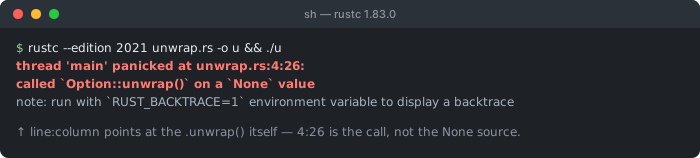
rustc 1.83.0. The line:column is precise — 4:26 is the .unwrap() call itself, not wherever the None came from. When the Option travelled some distance before being unwrapped, that distinction is the whole debugging task, and .expect("...") with a real message is what closes it.An Option<T> is either Some(value) or None — Rust's way of forcing you to acknowledge that a value might be absent. Calling .unwrap() says “I'm certain this is Some; give me the value, and crash if I'm wrong.” When the Option is actually None, that's exactly what happens: the current thread panics (and the program aborts unless something catches it, e.g. with catch_unwind, or the panic strategy is set to abort, in which case the whole process ends immediately). The fix is never to make unwrap “work” — it's to decide what should happen when the value is missing, and use the method that expresses it.
The unwrap ladder: choose by what should happen on None
Start from what the code should do when the value is absent, then read across to the method that expresses it — unwrap is only the right answer in the bottom row.
Fix 1: supply a fallback with unwrap_or / unwrap_or_else
let port = config.get("port").map(String::as_str).unwrap_or("8080");   // eager default
let id = cache.lookup(key).unwrap_or_else(|| generate_id());           // lazy — only runs on None
let count = maybe_count.unwrap_or_default();                            // 0 for numbers, "" for String
Use unwrap_or for a cheap constant, unwrap_or_else when computing the fallback is expensive (the closure only runs on None), and unwrap_or_default when the type's Default is what you want. One footgun to know about: config.get("port").unwrap_or(&"8080".to_string()) looks reasonable but won't compile — the "8080".to_string() temporary is dropped at the end of the statement, so the reference to it can't outlive the borrow (E0716: temporary value dropped while borrowed). Rust only extends a temporary's lifetime when the &expr sits directly in a let binding, not inside a method-call argument. Going through &str via .map(String::as_str), as above, sidesteps the problem entirely.
Fix 2: branch explicitly with match or if let
match users.get(&id) {
    Some(user) => println!("found {}", user.name),
    None => println!("no user with id {id}"),
}

// or, when you only care about the Some case:
if let Some(user) = users.get(&id) {
    println!("found {}", user.name);
}
Fix 3: propagate None with the ? operator
In a function that returns Option, ? extracts the value from a Some (it doesn't unwrap in the panicking sense) and returns None from the whole function the instant any step is absent — letting you chain lookups without a pyramid of matches:
fn first_admin_email(users: &[User]) -> Option<&str> {
    let admin = users.iter().find(|u| u.is_admin)?;   // None here → return None
    let email = admin.email.as_deref()?;              // None here → return None
    Some(email)
}
The enclosing function must return Option (or Result) for ? to be allowed — that's what it short-circuits into.
Fix 4: if it really can't be None, use expect
When None would genuinely be a bug — an invariant your program guarantees — a panic is acceptable, but make it self-explaining. Prefer expect over unwrap:
// ❌ bare panic, no context for whoever hits it
let cfg = load_config().unwrap();

// ✅ same panic, but it documents the assumption
let cfg = load_config().expect("config was validated at startup — this can't be None");
The two produce identical behavior on None, but expect's message tells the next engineer which invariant was violated instead of leaving them to reverse-engineer it from a line number.
Fix 5: transform without unwrapping (map, and_then)
Often you don't need the raw value at all — you need to do something with it if it's present. The combinator methods let you keep working inside the Option and never risk a panic:
// map: transform the inner value if Some, stay None otherwise
let len: Option<usize> = name.map(|n| n.len());

// and_then: chain another Option-returning step (flatMap)
let city: Option<&str> = user.address.as_ref().and_then(|a| a.city.as_deref());

// filter: keep Some only if a predicate holds
let positive = count.filter(|&n| n > 0);
These read top-to-bottom and compose cleanly, which is why idiomatic Rust reaches for them long before unwrap. When you finally need a concrete value at the end of a chain, close it out with one of the ladder's safe endings (unwrap_or, match, or ?).
Turning Option into Result with ok_or
When a missing value should become a real error to propagate — not just a None — convert with ok_or / ok_or_else, then use ? to bubble it up as an Err:
fn load_user(id: u32) -> Result<User, AppError> {
    let user = cache.get(&id).ok_or(AppError::NotFound(id))?;   // None → Err, propagated
    Ok(user.clone())
}
The same applies to Result
.unwrap() on a Result that's Err panics identically (“called Result::unwrap() on an Err value”). The ladder maps across: unwrap_or/unwrap_or_else for a fallback, match to branch on Ok/Err, ? to propagate the error, and expect for a documented invariant.
Debugging checklist
- ✓ Decide first: on
None, do you want a default, a branch, an early return, or a crash? - ✓ Default →
unwrap_or/unwrap_or_else/unwrap_or_default - ✓ Branch →
matchorif let Some(x) - ✓ Propagate →
?(function must returnOption/Result) - ✓ Genuinely impossible →
expect("reason"), never bareunwrap() - ✓ Set
RUST_BACKTRACE=1to see the full stack to the panic
Frequently Asked Questions
What does 'called Option::unwrap() on a None value' mean?
You called .unwrap() on an Option that turned out to be None. unwrap() means ‘give me the value inside, and panic if there isn't one’ — so when the Option is None, it panics and aborts the thread. The same applies to Result: .unwrap() on an Err panics with ‘called Result::unwrap() on an Err value’. It's not a compile error; it's a deliberate runtime crash you asked for by using unwrap().
How do I fix an unwrap panic on None?
Replace unwrap() with a form that handles the None case: use match or if let to branch, unwrap_or(default) to supply a fallback value, unwrap_or_else(|| ...) for a computed fallback, or the ? operator to propagate None up to the caller. Which one depends on what should happen when the value is absent — a default, an early return, or a specific error.
Is unwrap() ever okay to use?
Yes — in tests, quick prototypes, and cases where None genuinely represents an unreachable state that would be a bug. When you do use it in real code, prefer expect("reason") over unwrap(): it produces the same panic but with a message explaining the invariant you're relying on, which turns a bare panic into a documented assumption for whoever debugs it later.
What's the difference between unwrap_or, unwrap_or_else, and unwrap_or_default?
All three replace None with a value instead of panicking. unwrap_or(x) uses x, which is evaluated eagerly even when the Option is Some — fine for cheap values. unwrap_or_else(|| expensive()) computes the fallback lazily via a closure, only when needed, so use it when the default is costly. unwrap_or_default() uses the type's Default implementation, e.g. 0 for numbers or an empty string.
How does the ? operator help with Option?
In a function that returns Option (or Result), value? extracts the value from a Some and, on None, immediately returns None from the whole function instead of panicking — it does not unwrap in the panicking sense. It's the cleanest way to chain several fallible lookups — each ? short-circuits to None the moment one step is absent, so the happy path reads linearly without nested matches. The enclosing function's return type must be Option or Result for ? to be allowed.
How do I see where the unwrap panic happened?
Run with RUST_BACKTRACE=1 (or RUST_BACKTRACE=full) set in the environment. The panic message already prints the file and line of the unwrap call, and the backtrace shows the full call stack that led there. Setting expect("...") messages on your unwraps also makes each panic self-identifying, so you don't have to guess which of several unwraps fired.
References
- Option::unwrap (Rust standard library)
- Error Handling (The Rust Programming Language)
More Rust & backend errors
Browse the full reference for Rust, Go, and Java errors — exact message, cause, and fix.